AI Prescription Reader & Document Manager
OCR + AI pipeline that reads handwritten prescriptions and files patient documents.
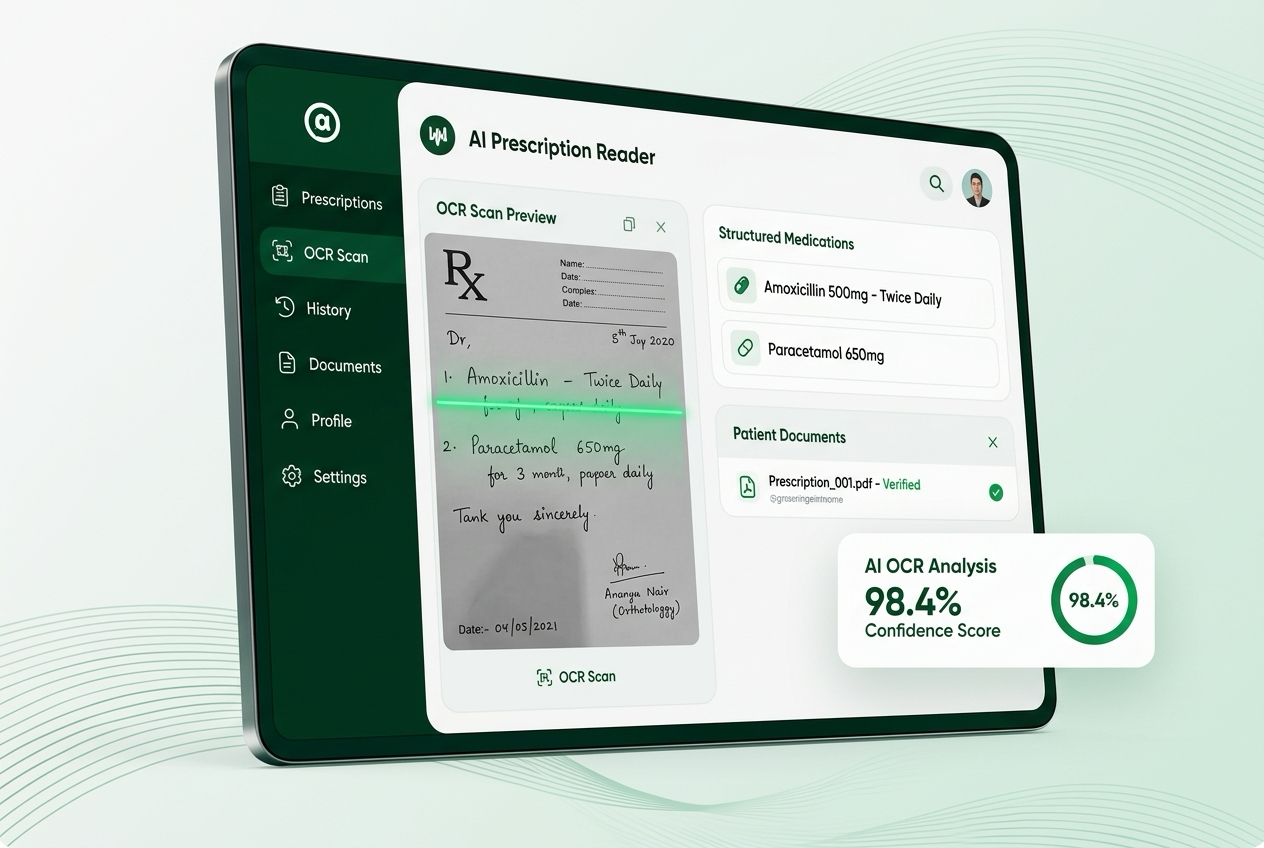
OCR Reading
AI Analysis
Document Management
Search & Classification
Human Verification
Company Snapshot
- Product
- AI Prescription Reader & Document Manager
- Category
- Healthcare AI / Document Intelligence
- Core Technologies
- OCR + AI + Document Processing + Structured Data Extraction
- Primary Users
- Healthcare Organizations, Administrative Teams & Authorized Healthcare Staff
- Architecture
- AI Document Processing Pipeline with Human-in-the-Loop Validation
- Primary Focus
- Converting unstructured healthcare documents into organized, searchable digital information
The Industry Challenge
Healthcare organizations handle a significant volume of documents every day — handwritten and printed prescriptions, lab reports, referrals, consultation notes and supporting files. Many still arrive as images, scans or physical paperwork, and a conventional document-storage system can store the file without understanding what's inside it. This creates real operational problems:
- Staff manually read prescriptions and re-key information into another system
- Doctor handwriting varies wildly in style, abbreviations and legibility
- A prescription is visually structured for humans but looks like just an image to software
- Finding a specific patient document later is difficult when files use inconsistent names or folders
- A patient's prescriptions and supporting documents end up scattered across multiple locations
- Staff spend significant time reviewing, renaming, categorizing and uploading documents by hand
The objective wasn't simply "convert image to text" — it was to convert healthcare documents into usable, structured information, with a human always in control of anything that reaches a patient record.
The Platform
What AI Prescription Reader & Document Manager's product suite is built to solve, end to end.
AI Prescription Reader
Core intelligence layer that processes prescription images and identifies useful information, including handwritten ones.
Handwritten Text Processing
Preprocessing — crop, deskew, enhance — improves recognition odds before OCR and AI interpretation run.
Medical Entity Extraction
Identifies patient, medication, dosage, frequency, duration, instructions and prescriber from raw OCR output.
Structured Prescription Output
Represents a processed prescription as structured, reviewable data instead of a block of OCR text.
Confidence-Aware AI Processing
Associates confidence scores with extracted fields, auto-structuring high-confidence data and flagging the rest.
Human Verification
Lets an authorized reviewer confirm, edit, correct, reject or reprocess extracted information against the original.
Document Classification
Automatically categorizes uploads — prescription, lab report, referral, consultation, insurance and more.
Patient Document Management
Organizes prescriptions, reports, referrals and supporting files into one patient document history.
Patient-Centric Document Timeline
Connects a patient's documents chronologically instead of scattering them across unrelated folders.
Smart Document Search
Searches by patient, document type, date, doctor, medication or status using extracted metadata.
Original Document Preservation
Keeps the source document linked to its extracted data so users can always verify against the original.
Document Version & Auditability
Records upload, processing, review, edit and access activity for every document.
Secure Document Access
Authentication, role-based permissions, patient-level access controls and audit logs protect sensitive files.
Role-Based Access
Administrator, Healthcare Staff, Reviewer and Authorized User each get access scoped to their responsibility.
AI Document Pipeline Architecture
Asynchronous queue-based processing keeps uploads responsive while OCR and AI extraction run in the background.
What We Delivered
The pieces that came together to build AI Prescription Reader & Document Manager's solution.
AI Prescription Reader
Combines OCR with an AI interpretation layer to handle handwriting variation, abbreviations and medical terminology.
Structured Entity Extraction
Turns raw OCR text into structured fields — patient, medication, dosage, frequency, duration and instructions.
Confidence-Aware Human Review
Low-confidence fields are flagged for verification instead of silently trusted, keeping a human in the loop.
Smart Document Search
Searches by patient, document type, date, doctor or medication — not just filename — across the full document history.
Inside the Build
A closer look at how the pieces fit together—shown as illustrative screens, not real product captures.
Illustrative screens — not actual product captures
Our Approach
How we moved from first conversation to delivered results.
Discover
Understood the goals, constraints and people involved.
Build & Integrate
Designed and built the solution, connecting every moving piece.
Launch
Shipped to real users with quality and transparency.
Support & Grow
Stayed on to support, refine and scale what we built.
Why It Matters
A traditional document-management system answers "where is the file?" An OCR system answers "what text is in the file?" This platform answers what kind of document it is, which patient it belongs to, what information it contains, which fields need review, and how it should be organized — the evolution from file storage to OCR to AI document understanding to structured healthcare data, with AI accelerating the work while humans remain in control of verification.
The Challenge
Healthcare organizations handle huge volumes of handwritten prescriptions, lab reports and patient documents that arrive as images, scans or paperwork. A conventional storage system can hold the file, but it doesn't understand what's inside it — leaving staff to manually read, enter, rename and file everything by hand.
Our Solution
The platform runs every document through an AI pipeline — image preprocessing, OCR, AI entity extraction, confidence-aware validation, patient association and classification — turning a scanned prescription into structured, searchable information while preserving the original document for verification.
The Results
What previously required multiple manual steps — read, transcribe, file, search — becomes a structured digital workflow: AI reads and structures the document, flags low-confidence fields, and a human reviewer confirms before it's stored and made searchable against the patient record.
More Case Studies
Explore how we've solved similar problems for other businesses.
 Construction Technology / Project Management
Construction Website with Work Management
Project tracking, crew scheduling and client-facing site for a construction firm.
 Hospitality Management / Hotel Operations
Treat Resort
Booking, housekeeping and guest experience management for hotel groups.
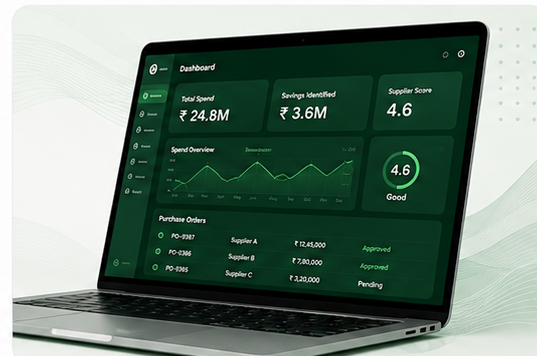 Procurement Technology / Business Intelligence
Purchase & Supplier Intelligence System
Supplier scoring, purchase-order automation and spend analytics dashboard.
Want Results Like This for Your Business?
Tell us about your goals and we'll design a roadmap built around your data and workflows.